Cliques

Thursday, June 30, 2011

R.I.P. Teddy

**Strictly 18 and above ONLY**

Watch at your own risk
.

How could someone be brutal enough to even bite something as cute as this? =D


...

BOOOOOOOM!


Who did this?!


23 April 2011
Another ordinary day... but.. EXTRAORDINARY to us!
The chemistry lab was again morbid since the making of smoke grenades months ago..

So... let's watch this trailer and in few seconds u will know the most brutal way to kill a gummy bear.


Therefore, to start off, what we basically need is simple:
1. A gummy bear (the one you hate most)
2. Potassium chlorate (salt formula: KClO3)
3. A set of retort stand, clamp, Bunsen burner and a lighter
4. A Pyrex combustion tube
5. And it is advised to do these precautions, just in case: a pair of gloves, and a pair of goggles
6. A pair of tongs
7. Forceps
8. Last but not least, for visualization purpose, get some table salt (sodium chloride or potassium chloride)!

Alright, to kill a gummy bear without regrets, here's the procedure... *smirk*
I. Gently place some potassium chlorate salt into a dry combustion tube (2-3 spatulas would suffice); it's better with a Pyrex combustion tube, just in case.
II. Clamp the combustion tube in a 45 degree slant position onto a retort stand, make sure it's tightly and stably clamped.
III. Now, light up the Bunsen burner (with a lighter, of course), and make sure you open the air hole to switch the flame blue, so that it burns hotter.
IV. Place the Bunsen burner right below the combustion tube and the heating starts.
V. As the potassium chlorate in the combustion tube takes its time to melt, start getting a gummy bear to stand by its queue of death~ Now, you may spread some NaCl or KCl evenly over the gummy bear so as to produce colored flame (yellow-orange in our case).
VI. After the potassium chlorate completely melts, meaning that now you've already obtained a solution of pure molten potassium chlorate, kindly use a pair of forceps, pick a gummy bear, and put it inside the tube. (Before that, you would like to switch the lights off!)
VII. See what happens. Enjoy! =)

President & Vice.
Jit Chern ??


Gaya woi.

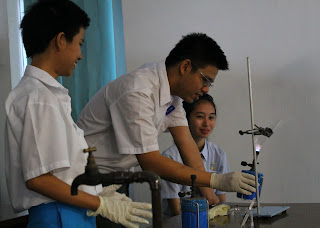
Teddy on fire.


Heating up the torture chamber with style.


Sensitive to lens~


??????????????????????????


Posers.

Before.

After.


Mak's Bird Day.


Some fine remarks over here.
First, as soon as the poor gummy bear touches the molten KClO3, things start to get real messy. Depending on the concentration of sugar in the bear itself and the amount of potassium chlorate you use, this experiment will present you with approximately 1 minute of astonishment. Now, let's discuss why this happens..
See, a gummy bear is made of sugar (like you don't know), mainly, sucrose. And potassium chlorate, in its molten form, is a very very very strong oxidizing agent. Basically, this experiment is just an oxidation reaction, but so strong that you will be able to observe vigorous flames and even explosions within the small and narrow reaction vessel -- the combustion tube.

So, what creates light and smoke in that abrasive manner with just a teddy and a pile of salts?
First, let's have a look at the reaction:

C12H22O11(s) + KCLO3(l) --> CO2(g) + H20(g) + KCL(g)
Sucrose + molten Potassium Chlorate --> Carbon Dioxide + Water Vapor + Potassium Chloride gas

What actually gives out the light that you observe? Well, due to the narrow space of the reacting vessel and the strength of KClO3, the energy produced in this reaction is so strong that only heat energy being produced could barely sustain the energy traffic which is, indeed, tremendous. And according to the Principle of Conservation of Energy, energy cannot be destroyed or created, but can be converted from one form to another. Thus, in this case, energy is so strong and vigorous that part of the energy released is converted into light energy, in spite of just heat energy which can be observed in the form of steam.


Alright, that's about it! But, one last thing: before commencing this experiment, be very sure that the ventilation is good, because there will be a lot of CO2 and KCl gases rushing out.

Let's KILL! =)

Sunday, May 29, 2011

EXPERIMENT 101

Saponification


As we all know, saponification is a simple process to produce soap from fats and lye. As some of us have not had their hands on in this experiment in Form 5, we decided to give it a shot!

The apparatus and materials needed are listed below.

Materials:
10cm3 palm oil
50cm3 NaOH
Distilled water
NaCl

Apparatus:
250cm3 Beaker
Glass rod
Bunsen burner,tripod stand
filter funnel
Filter paper
Measuring cylinder
spatula

The procedure are as follows.
1)10cm3 palm oil and 50cm3 NaOH is poured into a 250cm3 beaker and heated for about 10minutes.
2) Then,100cm3 distilled water is added into the heated mixture. Simultaneously, add in three spatulas of NaCl.
3)Heat it fro another 5 to 10minutes and leave it to cool.
4)Mixture is then filtered using filter funnel.
5) The sediments are rinsed with distilled water.

There you have it! Non-fragrant oily soap! :D


Filtration process with filter funnel and filter paper. Those floating sediments are soap :)


Pei Wen, looking happy.


Jit cherng, flashing his pearly whites.


Jan jhin, with his poker face. ):


Saturday, January 22, 2011

Superflower: Rafflesia

*Rafflesia arnoldii


Kingdom: Plantae
Division: Magnoliophyta
Class: Magnoliopsida
Order: Malpighiales
Family: Rafflesiaceae
Genus: Rafflesia


*Rafflesia labelled

______________________________________________________

THE biggest flower of all - Rafflesia is named after Sir Thomas Stamford Raffles who first discovered its wonderful existence in an expedition cutting through Indonesian rain forest.

These giants have no stems, leaves or true roots, and are classified as a genus of parasitic flowering plants. They are known as endoparasites of vines, spreading their absorptive organs, called haustorium, inside the tissue of the vine.

WIKIPEDIA: "In botany, a haustorium (plural haustoria) is the appendage or portion of a parasitic fungus (the hyphal tip) or of the root of a parasitic plant (such as the broomrape family or mistletoe) that penetrates the host's tissue and draws nutrients from it. Haustoria do not penetrate the host's cell membranes."
*Structure and anatomy of a haustorium


*Haustorium of parasitic plant (greenish) resembling Rafflesia, penetrating through the vascular tissues of its host (bluish) to obtain nutrients parasitically


Indeed, it is the presence of haustorium that makes Rafflesia a parasitic plant. Thus, in fact the only part of the plant that can be seen outside the host vine is the five-petaled flower. The diameter of the flower may be over 1 metre and might even weigh up to 10 kilograms. The flowers smell like rotting flesh, giving it some local names like 'corpse flower'. But, in return, it is this vile and unpleasant smell that functions as the mean of reproduction. Such smelly aroma the flower gives off attracts insects such as flies, which then transport pollen from male to female flowers. Despite that, some very few species of Rafflesia have bisexual flowers.

*Note the flies on this Rafflesia - it stinks but works!

*Lifecycle of ordinary Rafflesia

*Parasitic Rafflesia having its firm grip on its host

*A sensational dive into the tropical monster

______________________________________________________

Until now, as what I opine, there still is a lack of thorough information within the bottommost of a Rafflesia. Believably, there are still many of these superflowers lying unknown out there, within the deepest, moistest and the most untouched evergreen of the tropical labyrinth, like giants awaiting some occasional attentions in deep silence...